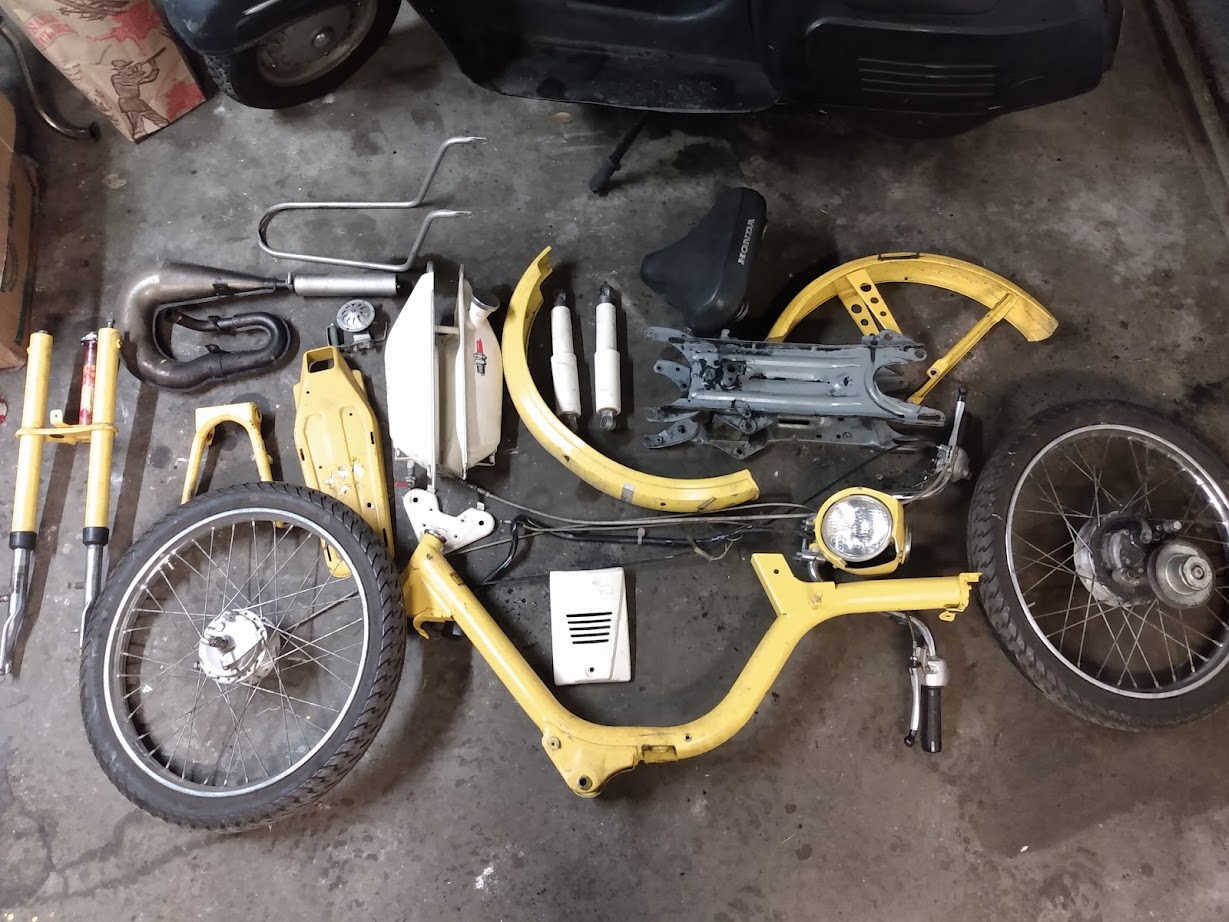
Thanks to the efforts of Nak'd Dav, my first ever moped (and racer during the '03-'06 Circleville days) is on the way from the Buckeye State. This bike will find its way into the forthcoming SUPER STOCK class of PSRA racing in 2012, likely powered by a ZA50 equipped with the swamp-thing cylinder. I'm jazzzzed.
Tuesday, January 31, 2012
Monday, October 31, 2011
Seats & Cylinders

So back in September I worked on a seat, the first I've made in awhile (2002). I think it came out pretty good. Liz gave me a few pointers patterning the pleather and did some of the final sewing of the cover. I built four identical seat frames and one for the smallframe. This is the only finished example so far. Its made out of wood and some high-density foam. Threaded inserts allow it to be mounted on the Vespa Si or a Puch type seat post.
The other day, thinking about the forthcoming SUPER STOCK class of moped racing in 2012, as well as my old Swamp-Thing Cylinder I decided to bring it in to work on Saturday and spend some quality lathe time. After fabricating a few bushing out of ABS to properly stabilize the cylinder in the lathe (one with a bearing) I was able to get to work. I'm glad now that I went to the trouble to make those bushing, as there will be more work to do with the cylinder. Working with lather-beams can be a sketchy re: dangerous proposition, particularly on your big floppy homemade cylinder.
Plans are in the works to bring both my first bike a 1961 Vespa VBB and first moped, a Puch Maxi-Luxe out to the Pacific Northwest. The cylinder will certainly be powering that bike at some point. I bought and rebuilt a hobbit PA50II recently, I'm debating selling it or keeping it, as they are such nice bikes to own.
Sunday, June 26, 2011
PSRA @ PIR
So this last weekend PSRA took the track with OMRRA, and got out on the big track for some hot, sticky, race action. PIR was originally designed for F1, it's 2 miles long, 90ft wide in places - a completely different venue than most scooter or moped racers are used to. The 'knife fight in an elevator' replaced with 'Battle for Pelennor Fields'. And while most of the technical challenge of racing might be lost, its good fun to let all the ponies loose for a change.
Thanks to Angus Muir for letting us ride along!
Sadly, predictably? I was not able to participate, due to my work commitments and still plenty to do to my smallframe. More on that soon.
Thanks to Angus Muir for letting us ride along!
Sadly, predictably? I was not able to participate, due to my work commitments and still plenty to do to my smallframe. More on that soon.
Monday, June 13, 2011
And ... we're... back ...
What a difference a day makes. Just like that, Monster Zero is Pre-Op for a heart transplant! With some luck, I'll be on the track crushing CB160's in a few weeks. Enough talk, back to the garage!
Saturday, February 19, 2011
TIE Fighters & Cephalopods
So, progress on my projects has been slow. My lack of a steady income is certainly a factor. I have completed the designs of the Jawa & Batavus cylinders I hope to someday produce, and I have nearly finished rebuilding a new vacu-forming rig for the flywheel covers. But its been a long while since a post and I have other interests outside bikes.So... Everybody knows what a TIE Fighter is right? The Galactic Empire's ubiquitous cannon fodder spaceships from Star Wars. Well, if you're a apex-level Nerd like me, you'll remember that "TIE" stands for Twin Ion Engine. In the Star Wars universe, the 'wings' on the TIE Fighter are actually solar panels, collecting energy to be used continuously. Well as it turns out, the next manned spacecraft effort may use this very concept. Not some watered down, lame, real world equivalent but pretty much exactly as pictured in the movies.
The idea was old even before George Lucas got his mitts on it. Sometimes Nazi, other times American, All-the-Time Rocket Genius Werner Von Braun first posited the idea back during the V-2 program in WWII. NASA built working a working example in 1959, and the Soviets used them as maneuvering thrusters since 1972. Critical issues with output prevented them being any more significant than that. Ion Propulsion works great in space, because of the ultra-high particle velocities responding to the Lorentz Force, rather than thermal conductivity in a conventional chemical rocket. After several expensive probe failures in the 90's NASA decided that rather than building complex, multi-purpose "Big Mission" projects; a slate of quick to launch, cheap to build, limited scope projects might bring better returns. Such was the case with Deep Space 1, a high-risk advanced technology project that intercepted an asteroid (with photography, not laser cannons). Because of its solar-powered Ion Rocket engine, and its autonomously functioning software, Deep Space 1 was able to chase down the comet Borrelly in 2001, years after it's mission with the asteroid was complete in 1998. (Deep Space 1 is still flying, btw)
Those of you who have read the blog awhile may remember my rant/obituary about manned spaceflight coming to a close : "To boldly go... way off topic" - may remember my conclusion that the biggest obstacle to our objectives in space is the crux politics down here on earth. Those plucky NASA eggheads may have done it: a politics-proof space craft? Walking away from the rubble of Constellation, the mothball smell of the soon-retired Shuttle fleet and now tasked with Obama's hope to land on an asteroid, or maybe Mars or whatever. Mark Holderman and Edward Henderson have developed a new concept, with the core innovation of dealing with the World as it is right now.
The concept is called Nautilus-X . It's a modular deep space exploration craft that can be configured for either a trip to the moon, to Mars, or a 2 year voyage to chase down an asteroid. (provided the on-board android doesn't try to murder you all) Because Nautilus-X uses almost all off-the-shelf componentry, like solar panels from a Hughes satellite, the same manipulator arm & docking module from the International Space Station, vast savings in both costs and time can be had. Nautilus-X uses some new technologies to manage the problems of long-term space flight (like cancer-causing cosmic particles, long term muscular atrophy). A major component of this plan is that it doesn't require a large amount of fuel, like a conventional rocket, just a small tank of Xenon gas to serve as the catalyst/substrate in the otherwise Solar-powered Ion engine. Like the Battlestar Galactica and the USS Enterprise of old, Nautilus-X will be assembled in space, tugged up in parcels by unmanned commercial rockets. Here are some images of the ship in two versions. Note the centrifugal ring, Nice!Light:
Heavy:
So let's review. Nautilus-X is:
1.Cheap.
2.Versatile for Multiple missions.
3.Realistic.
4.Available right now.
Wednesday, December 22, 2010
Everybody loves Port Maps!
Lots of people know what a Port Map is. The number of people who know how to interpret these primitive etchings continues to grow. I've been collecting port maps for the last decade or so, at the various shops that I've worked at. Now I'll share a few, the highlight reel anyway. Sorry about my chickenscratch handwriting and lunatic scribblings, also.
Jawa 207
Laura M48 / Batavus
Honda NSR50
Crazy 80's Eurocilindro 125 LC for Vespa Smallframe
Honda RS125
Malossi 172 Italjet Dragster
Polini 43mm for Vespa Ciao
Polini 177 for Vespa largeframe
Gilardoni 75cc for Puch
DR102cc for Vespa 50 smallframe
Malossi 136cc for Vespa Smallframe 125
Wednesday, November 24, 2010
Offerings
I heard that Toyota spends over a million dollars a day on research and development. If you're a enormous company like Toyota, having an robust R&D department allows your company to compete in an increasingly technologically sophisticated market. But, 'research and development' is a nice way of saying repetitive failure. I will remind myself that I am engaged in 'research and development' and remember how far I've progressed in making things. Over a month ago I was busy cracking the combination of heat and time necessary to produce the plastic flywheel covers. A modification to the rig had eliminated the wrinkles that were plaguing the process.
The picture at right is a bunch of the 'almost good enough's' that were fully formed but flawed in one way or another. Since the whole point of this is to make your bike look cooler, having a part with a distracting flaw simply won't do. The biggest problem, is getting the plastic to remove cleanly off the rig. Right now the mechanism that is supposed to eject parts, mostly just breaks them. Also, the hotter the plastic, the more detail it picks up, but this causes bubble to form -so that's the other problem. I haven't worked on this in awhile because I got a gig with OMSI, a gig that has recently concluded.
While at OMSI, after a brief conversation, one of the exhibit guys I worked with gave me his bottles of Smooth-On 300 casting resin. 'Since I don't need them.' This fired up my interest in my old cylinder casting schemes. If you've been on the Moped Army Buy/Sell forum, you may have noticed my attempts to collect suitable specimens for this project.
Mopeds have no shortage of diversity, there are a billion types out there. But only a select group take center stage: Puch/Tomos, Peugeot, Honda Hobbit, Derbi, and to a lesser extent Vespa, Mobylette and Minarelli. If you choose a rare bike, after all the effort of restoration, rebuilding and maintenance, you still only have a bike that goes 25mph, and will likely be at the pack of the pack in a ride, or struggle to climb hills. So, if I'm going to dinker around with cylinder production, I'd like to do so in a way that encourages diversity in the "scene." Some people (Aaron, Joeped, Nate) are f**kin radical enough to offer up their old cylinders to be apart of this mutant rebellion, others I had to buy. But within a relatively brief time, I've collected -or have en route a stable of barrels ready for cloning.
Last night I went with Liz to pick up the Garelli NOI cylinder from Nate. As we we're talking I realized that my explanation of the 'cloning' process doesn't make any conversational sense. So, for anyone interested, I drew up a sketch to illustrate this phase of the process. *also- anyone who has experience with this (Jan Thiel, I'm looking at you) let me know what I'm doing wrong.
First off, know that the objective is to create an accurate wax copy of the cylinder, with the important exception of the port layout, transfers and exhaust. -we eject the stock stuff. But again- a wax cylinder is what we want.
1. If you were to fill all the space inside a cylinder with say, silicone; it would create a copy of the ports, transfers, the bore itself, etc.. If you pulled that silicone out of the cylinder, you would have a 'negative' of that cylinder. - A 20hp Malossi MHR scooter jug in this case. Thats what #1 is here in the drawing.
2. Take the negative (#1) and then coat it with wax, and keep building up the wax around it, filling in all the nooks and crannies, giving it some thickness. Then remove #1 and what you've got left is a wax copy of the internals of the original cylinder. Not a negative but a copy. This part (#2) is the insert.
3. This is actually a two-part step here. The blocks pictured are a mold of one of the cylinders we're cloning, a Jawa 207, for example. Presuming we've already made that mold, we take the empty mold and plug the insert (#2) into the mold (#3) Close the mold together and fill it with wax. Obviously, we'll make sure the wax doesn't fill the cylinder, just around it.
When you pull the mold apart, you should have a clone of a Jawa 207 cylinder with Malossi MHR internals. This explanation is an over-simplification, but shows the process. There are lots of adjustments that have to be made to account for stroke, crown height, rod length, etc.. differences. You might have noticed that the Vespa and Derbi cylinders above both have a "registration" (highlighted) cut in the bore. After a mold is made from these cylinders, this insures the wax insert stays centered in the mold during the wax filling portion.
As mentioned before, I'm sure there will be plenty of trial and error on the way. (like Smooth-On 300, not so good actually) Because of these difficulties, and because my money is limited, -who are we kidding - my attention span is too, I hope you'll vote in the poll on the sidebar, to prioritize my efforts.
The picture at right is a bunch of the 'almost good enough's' that were fully formed but flawed in one way or another. Since the whole point of this is to make your bike look cooler, having a part with a distracting flaw simply won't do. The biggest problem, is getting the plastic to remove cleanly off the rig. Right now the mechanism that is supposed to eject parts, mostly just breaks them. Also, the hotter the plastic, the more detail it picks up, but this causes bubble to form -so that's the other problem. I haven't worked on this in awhile because I got a gig with OMSI, a gig that has recently concluded.
While at OMSI, after a brief conversation, one of the exhibit guys I worked with gave me his bottles of Smooth-On 300 casting resin. 'Since I don't need them.' This fired up my interest in my old cylinder casting schemes. If you've been on the Moped Army Buy/Sell forum, you may have noticed my attempts to collect suitable specimens for this project.
Mopeds have no shortage of diversity, there are a billion types out there. But only a select group take center stage: Puch/Tomos, Peugeot, Honda Hobbit, Derbi, and to a lesser extent Vespa, Mobylette and Minarelli. If you choose a rare bike, after all the effort of restoration, rebuilding and maintenance, you still only have a bike that goes 25mph, and will likely be at the pack of the pack in a ride, or struggle to climb hills. So, if I'm going to dinker around with cylinder production, I'd like to do so in a way that encourages diversity in the "scene." Some people (Aaron, Joeped, Nate) are f**kin radical enough to offer up their old cylinders to be apart of this mutant rebellion, others I had to buy. But within a relatively brief time, I've collected -or have en route a stable of barrels ready for cloning.
Last night I went with Liz to pick up the Garelli NOI cylinder from Nate. As we we're talking I realized that my explanation of the 'cloning' process doesn't make any conversational sense. So, for anyone interested, I drew up a sketch to illustrate this phase of the process. *also- anyone who has experience with this (Jan Thiel, I'm looking at you) let me know what I'm doing wrong.
First off, know that the objective is to create an accurate wax copy of the cylinder, with the important exception of the port layout, transfers and exhaust. -we eject the stock stuff. But again- a wax cylinder is what we want.
1. If you were to fill all the space inside a cylinder with say, silicone; it would create a copy of the ports, transfers, the bore itself, etc.. If you pulled that silicone out of the cylinder, you would have a 'negative' of that cylinder. - A 20hp Malossi MHR scooter jug in this case. Thats what #1 is here in the drawing.
2. Take the negative (#1) and then coat it with wax, and keep building up the wax around it, filling in all the nooks and crannies, giving it some thickness. Then remove #1 and what you've got left is a wax copy of the internals of the original cylinder. Not a negative but a copy. This part (#2) is the insert.
3. This is actually a two-part step here. The blocks pictured are a mold of one of the cylinders we're cloning, a Jawa 207, for example. Presuming we've already made that mold, we take the empty mold and plug the insert (#2) into the mold (#3) Close the mold together and fill it with wax. Obviously, we'll make sure the wax doesn't fill the cylinder, just around it.
When you pull the mold apart, you should have a clone of a Jawa 207 cylinder with Malossi MHR internals. This explanation is an over-simplification, but shows the process. There are lots of adjustments that have to be made to account for stroke, crown height, rod length, etc.. differences. You might have noticed that the Vespa and Derbi cylinders above both have a "registration" (highlighted) cut in the bore. After a mold is made from these cylinders, this insures the wax insert stays centered in the mold during the wax filling portion.
As mentioned before, I'm sure there will be plenty of trial and error on the way. (like Smooth-On 300, not so good actually) Because of these difficulties, and because my money is limited, -who are we kidding - my attention span is too, I hope you'll vote in the poll on the sidebar, to prioritize my efforts.
Subscribe to:
Posts (Atom)


