Enjoy 'em while you can
: Friday, May 14th, The space shuttle
Atlantis STS-132, will blast off for the second to last ever Space Shuttle launch. The final launch of
Endeavour in November 2010, STS-134, will be the
final launch of the space shuttle program, effectively ending the manned spaceflight program in the United States. ...Indefinitely. Given the rate at which aerospace programs develop, it could seriously be 30 years before another U.S. spacecraft breaks the surly bonds and sends men & women into outer space.

Is this news to you? Allow me to recap. The first ever Space Shuttle (
Columbia) was originally delivered to the Kennedy Space Center on March 25, 1979, coincidentally the same day I was born. The first launch of the space shuttle was in April, 1981. Given the stresses involved in leaving and returning to Earth's atmosphere, the service life of the typical shuttle was estimated at 30 years. (A timeline sealed by the 2003 destruction of
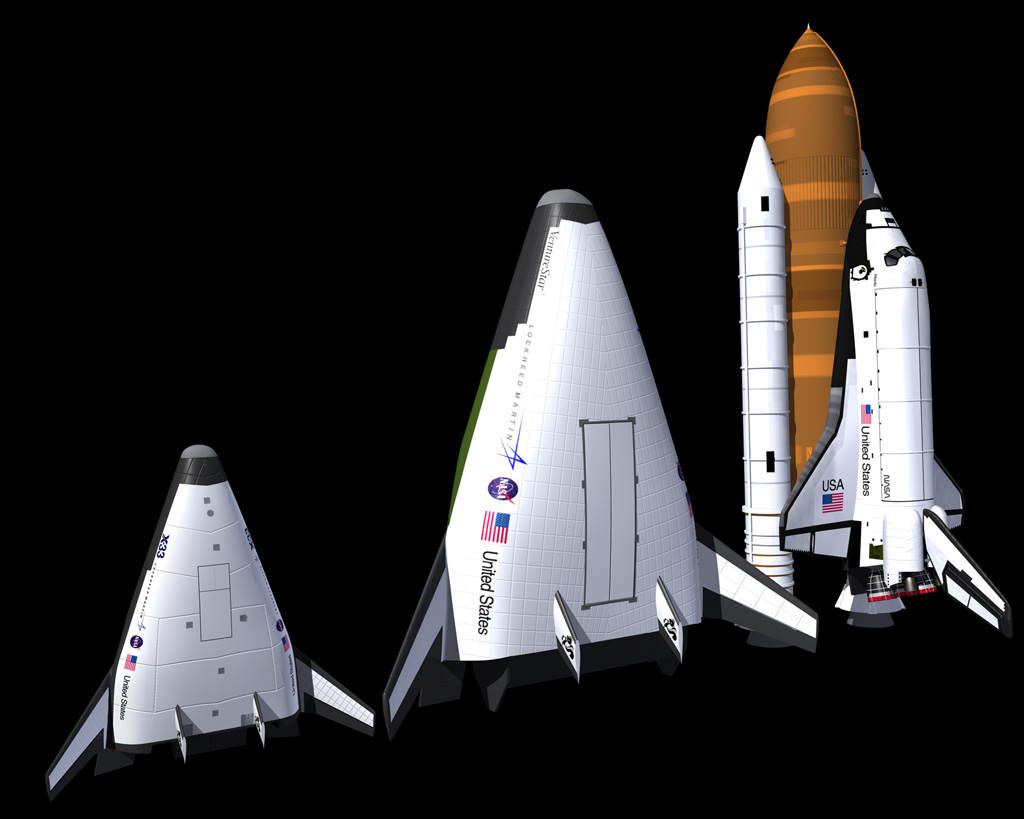
Columbia) NASA & US Air Force chose to develop a new craft rather than request funding to build a larger Shuttle fleet. This new craft was proposed to place a low-cost orbiter within the reach of private corporations, while simultaneously developing frontier technologies and drastically reduce overall mission costs for NASA. The new experimental ship was called the X-33, with a larger production version follow-up called the Venture Star. X-33/Venture Star was planned to be active by the time the original space shuttle fleet was retiring. -but that was before Narloy-Z.

The reason the X-33 could be so cheap and still get the job done is because it doesn't require a large external fuel tank or solid rocket boosters; not to mention eliminating SRBs makes space travel
much, much safer. The reason the X-33 didn't need the external periphery is because it was to use a
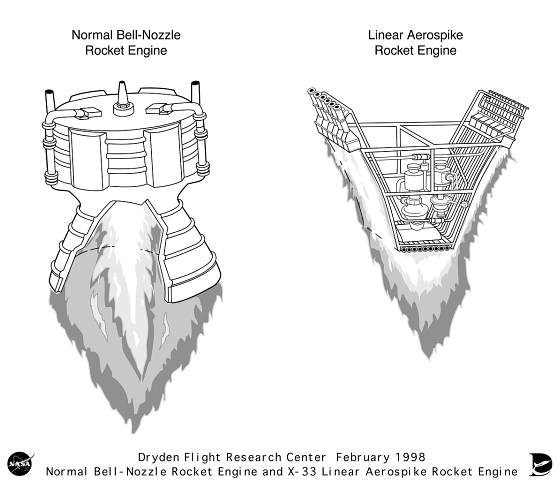
RS-2200 Linear Aerospike engine. The conventional rocket engine uses a bell-shaped thrust nozzle. The design of the thrust nozzle greatly determines the amount of power it's capable of producing. Just as a two-stroke expansion chamber exhaust performs optimally at a specific RPM, rocket nozzles perform optimally at a specific altitude and air pressure. Thing is; rockets aren't supposed to stay at specific altitude, they're supposed to shoot through them. As a result, traditional rocket engines spend most of their lives outside the powerband.

Now, a
linear aerospike engine doesn't have that problem. The RS-2200 uses a pair of variable geometry ramps to maintain optimum explosive pressure regardless of altitude. The new engine is 30% more fuel efficient than the older engine, and as a result, all fuel tanks could be internalized. As you can imagine, even with liquid hydrogen cooling from within, the stress on the ramps directing a river of exploding rocket fuel is quite tremendous, and the original material was insufficient for the task. X-33 engineers reluctantly selected Narloy-Z to build the ramps, which was tougher albeit significantly heavier. In doing so, this altered the flight characteristics and the weight difference had to be accounted for elsewhere. The engineers spent a lot of time and money developing a composite tank for the liquid hydrogen fuel, but met with repeated failure. The traditional Aluminum-Lithium tank worked flawlessly, but required a revision of the entire frame to meet the needed power-to-weight ratio. At this point, despite numerous NASA & USAF challenges, the off schedule and over budget X-33 was canceled, but mostly to make way for
Constellation.

Rather than support a high-technology, low unit-cost vehicle that could open up private spacecraft enterprise, the Bush Administration favored a robust, far reaching, long-term approach to space exploration. The plan was to return men to the moon, but rather than just planting the stars & stripes and collecting rock samples,
Constellation would also deliver modular units to be assembled as a semi-permanent base on the moon. With the larger orbit of the moon and its low gravity, the moon in many ways makes for a superior 'jumping off' point for missions to Mars and the other planets in the solar system. But... with the War on Terror, Operation Iraqi Freedom, and the publics' general lack of confidence in all things Pres. Bush, the idea of a "
Moon Base" seemed ridiculous. Regardless, NASA engineers progressed with plans to return to the Moon in a similar fashion to the Apollo missions. The last few years have seen the current crop of NASA Scientists and engineers scouring for resources to essentially create a high-tech Apollo sequel with early missions in the late 2010's and moon landings in the early 2020's.

With 9 Billion invested, President Obama terminated
Constellation across the weekend of April 15, 2010. Obama's new plan relies on the rise of (as of yet non-existent) commercial spaceflight providers to fly astronauts to the International Space Station, with the Russian space program filling the interim gap of... an unknown duration. The other initiatives set aside funding for research on a mission to land on an asteroid, earth based astronomy and emphasis on earth-centered exploration, with particular focus on climate change. In escence we will go from the clear global leader in manned spaceflight, to relative nobodys with zero experience overnight. The private leader in which Obama has placed his trust is Elon Musk, co-founder of PayPal and owner of SpaceX, a company which to date has launched 1 of their primary rockets. -Compared to the
thousands of launches and the
hundreds of manned spaceflights NASA has successfully and safely conducted. Killing
Constellation to force NASA to sit on its laurels, waiting for amateur hour to play catch-up will cost about 6,000 jobs at Cape Canaveral. Most of those jobs are highly technical and specific to spaceflight; it will also cost another est. 14,000 jobs in the greater community. This in a time where job creation is allegedly a priority, where we hand out vast fortunes to down-on-their-luck bankers, auto-giants and nearly any yacht owner with a frowny face.

The biggest bummer for me is that at one time as a kid I fantasized about being an astronaut; and now as a grown man I get to learn that even if i ate my Wheaties, and did my push-ups, and studied real hard to be an astronaut, it wouldn't have mattered. A lot of people ask, What's the point? Why spend all that money? There's a lot of poetic, soul-searching responses that you either already get and don't need to be told, or that you will simply never understand. So I'll provide a practical answer: Look at the computer in front of you, or your cellphone, or
thisisphotobomb.com. NASA is the benevolent arm of an innovation machine. We live in an 'information age' whose economy all hums along on microprocessors. Think about how much we use computers in our daily lives, if you're old enough, think about life before the internet or before you owned a computer. Microprocessors are the direct descendants of the Integrated Circuit, which was developed purely because vacuum tubes couldn't withstand the violent shaking and G-forces of a rocket launch -one of the first ever integrated circuit computers was the
Apollo Guidance Computer. Obama wants to create a
'Green Ecomony'- he has a industry legend at his fingertips; Silicon Photovoltaics (Solar Cells) were invented by NASA. NASA has been using Fuel Cells in satellites and spacecraft for decades. If anything, that is NASA's value: huge life-altering innovations.
Some food for thought. The Over-Budget & Off-Schedule X-33's entire program budget was 1.3 Billion dollars. That equates to 5 days of occupation in Iraq at the height of the occupation, or 2/10ths of 1 percent (0.002) of the bank bailout. It's still a chunk of change, but we've spent far more money in far less effective ways.

The way I see it, the biggest threat to manned spaceflight is the meddlings of the President of the United States. If not for Bush's far-off vision, and Obama's complete lack of vision, we would not be in this situation right now. The X-33/ Venture Star was supposed to be the torch that NASA handed off to the private sector, to initiate private spaceflight. If it hadn't been canceled, the technical issues could have been sorted out - for a fraction of the cost of Constellation- without damaging the livelihoods of the average NASA engineer, and without US Astronauts having to cross their fingers on a rocket ride with Captain PayPal. In November or whenever the last launch ends up being scheduled, I will make the trip (pilgrimage?) to see the final Shuttle launch. I will raise my Mai Tai or Corona to the heavens and offer a salute to the life and death of a beautiful and truly inspired era known as "The Space Age".


 Regardless, I needed to find a beefier shock with similar dimensions to the one I had, but that was a bit tough, and most quality shocks of this sort go for around $400, even a good spring for a motorcross application retails around $120, and the dimensions would still be a rough fit. Luckily, I was able to get a couple of random industrial springs with appropriate specs for not very much money. The thinner one is rated at 470lbs. and the thicker at 790lbs. Both springs match the outer diameter of the original and are 8in. long.